October 28, 2026
By THE HUB OF KNOWLEDGE
Cyber threats are no longer just an IT problem. They are a boardroom problem. Organizations everywhere are looking for professionals who can do more than configure firewalls: people who can build security strategy, manage risk, and lead the response when things go wrong. That is exactly what the Certified Information Security Manager (CISM) certification is designed to prove.
At THE HUB OF KNOWLEDGE, we help aspiring and experienced security professionals prepare for this globally respected credential. In this post, we explain what CISM is, why it matters, and how the right training can set you up to pass with confidence.
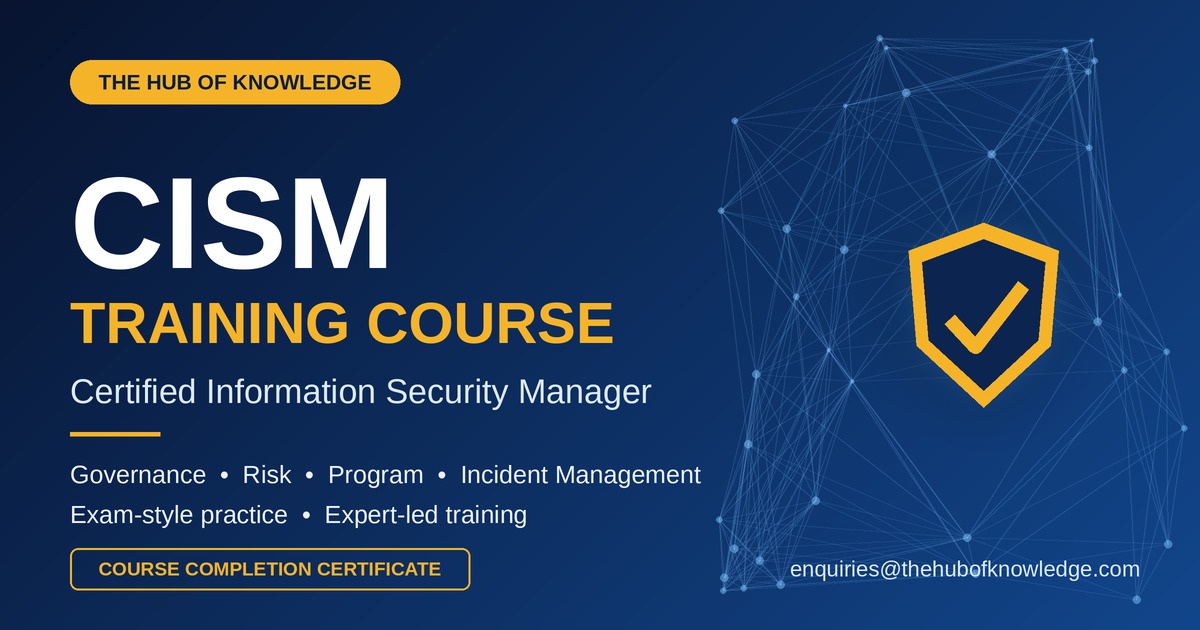
CISM is a globally recognized certification aimed at professionals who manage, design, oversee and assess an enterprise's information security. Unlike purely technical certifications, CISM focuses on the management side of security: governance, risk, program development and incident response. It is widely recognized by employers across industries and regions.
1. It signals leadership readiness. CISM shows that you understand how security aligns with business goals, not just how to operate tools.
2. It supports career growth. The certification is commonly associated with roles such as Information Security Manager, IT Risk Manager, Security Consultant, Compliance Manager and Chief Information Security Officer (CISO).
3. It carries global credibility. CISM is recognized internationally, which is valuable if you plan to work across borders or with multinational organizations.
4. It builds a common language. CISM teaches you to communicate risk and security priorities in terms executives and stakeholders understand.
The exam is built around four domains. Here is a general overview:
The exam is scenario-driven. It tests judgment as much as knowledge, asking what a security manager should do first or best in a given situation.
CISM suits professionals who already have some experience in information security and want to move into management, as well as current managers who want formal recognition of their skills. The certification requires relevant work experience in information security management, though some education and other certifications may count toward part of it. Contact us and we will help you work out where you stand.
It is possible to self-study for CISM, but many candidates find that structured training saves time and improves results. A good training program should offer:
By the end of our CISM training, you will be able to:
1. What does CISM stand for?
CISM stands for Certified Information Security Manager. It is a globally recognized, management-focused information security certification.
2. Who should take CISM training?
Information security managers, aspiring CISOs, IT risk and compliance professionals, security consultants, auditors and IT managers with security responsibilities all benefit from CISM training.
3. Is CISM harder than other security certifications?
It is different rather than simply harder. CISM is less technical than certifications focused on hands-on skills, but its scenario-based questions require sound management judgment, which takes practice to develop.
4. What are the experience requirements for CISM?
The certification requires professional work experience in information security management. Some education and other qualifications may be counted toward part of it. You can sit the exam before meeting the experience requirement, but certification is only awarded once you do. Contact us and we will help you check where you stand.
5. What topics does CISM training cover?
Training covers the four CISM domains: Information Security Governance, Information Security Risk Management, Information Security Program, and Incident Management.
6. What is the format of the CISM exam?
The exam is made up of multiple-choice questions delivered within a fixed time limit. Questions are scenario-driven and test how you would apply concepts as a security manager. Ask us for the current number of questions, duration and passing score.
7. How long does it take to prepare for the exam?
This depends on your background and study time. Many candidates prepare over several weeks to a few months. Structured training with a clear study plan helps you stay on track.
8. Do I need a technical background to pass?
A security background helps, but CISM is built around governance, risk and management decision-making rather than deep technical configuration. Candidates from audit, risk, compliance and IT management backgrounds often do well.
9. Can I study for CISM on my own instead of taking a course?
Yes, but self-study can be slow and it is easy to miss gaps. Training gives you a structured path, expert explanations, exam strategies and the chance to ask questions as you go.
10. What study materials will I need?
Official review materials and question databases are widely used, along with your training notes and practice exams. Ask us what is included with your course.
11. How should I approach CISM exam questions?
Think like a security manager. Look for the answer that best supports business objectives, follows risk-based decision-making and addresses the root of the problem rather than a purely technical fix.
12. What jobs can I get after earning CISM?
Common roles include Information Security Manager, IT Risk Manager, Security Consultant, Compliance Manager, Security Program Director and CISO. The certification can also strengthen your case for promotion.
13. Will CISM increase my salary?
CISM is widely regarded as valuable for career advancement, and many employers prefer or require it for management roles. Actual salary outcomes depend on your experience, role, employer and location.
14. How long does the certification last, and how do I keep it?
CISM must be maintained. This involves earning continuing professional education (CPE) hours and paying annual maintenance fees, and adhering to a code of ethics. Ask us for the current requirements.
15. How can I enrol in CISM training with THE HUB OF KNOWLEDGE?
Email us at enquiries@thehubofknowledge.com and we will share available schedules, training formats and pricing, and answer any other questions you have. Everyone who completes the course receives a course completion certificate.
At THE HUB OF KNOWLEDGE, our mission is to make professional certification achievable and practical. Whether you are taking your first step toward security leadership or finalizing your preparation for exam day, our CISM training is designed to give you the knowledge, confidence and strategy you need.
Ready to take the next step in your cybersecurity career?
Contact us today to learn more about our CISM training schedules, formats and pricing:
Enquiries: enquiries@thehubofknowledge.com
For Corporates: https://thehubofknowledge.com/onsite
Course Syllabus:Click here
Latest Posts
Stay Updated
Get latest updates directly to your inbox.
 Enquire Now

 info@thehubofknowledge.com